Imagine closing more deals in less time, while keeping the genuine connections that win big clients. In 2025, the ai bdr is transforming B2B sales, with 81% of sales teams now leveraging AI to automate and optimize results.
Traditional BDRs spend 66% of their time on repetitive tasks, leading to missed opportunities and inefficiency. This guide provides actionable strategies to help you streamline workflows, boost conversions, and outpace competitors.
Ready to embrace the future? Discover what an ai bdr is, how it works, key benefits, top tools for 2025, implementation challenges, future trends, and the best practices for successful human-AI collaboration.
What is an AI BDR? Core Concepts & Evolution
Understanding the ai bdr is key to unlocking the next level of sales productivity. In this section, we break down what an ai bdr is, how this role has evolved, the technologies powering it, and why it’s a must-have for modern sales teams.

Defining the AI BDR Role
An ai bdr is an intelligent software agent that automates the critical tasks of a business development representative. It leverages machine learning, natural language processing, and advanced data mining to handle lead generation, data enrichment, outreach, and follow-ups.
Unlike traditional BDRs, which rely on manual processes, an ai bdr automates repetitive work, freeing up human reps for higher-level strategy. Humans still provide strategic direction, setting the playbook and reviewing messaging to ensure quality. For example, Artisan’s Ava automates outbound demand generation while keeping humans in the loop. In fact, 60% of SaaS companies now use AI to automate sales tasks. For a deeper dive into the differences, check out AI-powered SDRs vs Classic SDRs.
| Traditional BDR | AI BDR | |
|---|---|---|
| Lead Research | Manual | Automated |
| Outreach | Manual Emails | Personalized AI |
| Data Entry | Manual | Real-time Sync |
| Follow-ups | Delayed | Instant, 24/7 |
The Changing BDR Workflow: From Manual to Automated
The workflow of a traditional BDR is filled with manual research, cold outreach, and tedious data entry. With the rise of the ai bdr, these time-consuming tasks are now streamlined. AI BDRs can scan through thousands of data points to identify ideal leads in seconds, then automatically sync this information to your CRM.
Follow-ups are no longer delayed, as AI tools send timely, context-aware messages based on prospect activity. This shift replaces the old "spray and pray" approach with targeted, trigger-based outreach. Data shows that BDRs spend 66% of their time on outreach, but an ai bdr can cut outbound activities in half, making teams far more efficient.
Key Technologies Powering AI BDRs
The backbone of every ai bdr is its integration of several powerful technologies. Machine learning enables smart lead scoring and prioritization, ensuring your team focuses on the highest-value prospects. Natural language processing customizes messages to resonate with each lead.
Seamless CRM integration with platforms like Salesforce and HubSpot ensures data stays current across all channels. Predictive analytics pinpoint high-intent leads, while real-time data syncing and workflow automation keep your pipeline active. For example, Clay uses real-time data to enrich leads and drive effective multi-channel outreach, all powered by the ai bdr stack.
Why AI BDRs Matter in 2025
The demand for efficiency and personalization in B2B sales is higher than ever, making the ai bdr essential for scaling operations. B2B sales cycles are more complex, requiring timely, relevant engagement at every stage. In 2025, ai bdrs are not a luxury, but a necessity for growth.
Currently, 39% of BDRs already use AI-based technologies, a figure that will only rise. The impact is clear: fewer missed opportunities, higher productivity, and increased conversion rates. Teams that embrace the ai bdr are better positioned to meet the growing demands of modern buyers and outperform competitors.
Key Benefits of AI BDRs for Modern Sales Teams
Unlocking the full power of ai bdr solutions brings dramatic advantages for sales teams. These benefits span from unmatched responsiveness to scalable personalization, making ai bdr a game-changer for modern sales organizations.

24/7 Outreach & Automated Follow-ups
An ai bdr never sleeps. With round-the-clock outreach, sales teams engage prospects at any hour, regardless of geography or time zone.
Automated follow-ups ensure no valuable lead is left waiting. Research shows that responding to leads within five minutes boosts conversion likelihood by 21x. ai bdr solutions send timely reminders and follow-up messages instantly, ensuring every opportunity receives prompt attention.
This always-on engagement eliminates the risk of leads slipping through the cracks. Human BDRs can focus on building relationships while the ai bdr handles high-frequency, repetitive touchpoints with precision.
Personalization at Scale
Scaling personalized outreach is one of the greatest strengths of an ai bdr. These tools analyze behaviors, preferences, and past interactions to generate tailored messages for each prospect.
Unlike traditional mail merges, an ai bdr adapts tone, content, and timing to match every lead’s context. For example, Ava can adjust its writing style based on a prospect’s communication history. This deep personalization drives higher engagement and reply rates.
For more on how to achieve this, see Personalizing Outreach at Scale with AI. Sales teams can now deliver individualized experiences to thousands of leads without sacrificing quality.
Enhanced Lead Conversion & Qualification
An ai bdr excels at qualifying and prioritizing leads. By leveraging real-time engagement signals, such as email opens, clicks, and replies, the system continuously scores prospects for intent.
This data-driven approach lets teams focus their efforts on the highest-value opportunities. Studies show that ai-powered lead scoring can increase conversion rates by up to 52 percent. B2B marketers report that AI chatbots and automation boost lead conversion rates significantly.
With an ai bdr, sales reps spend less time chasing cold leads and more time closing deals that matter.
Cost Efficiency & Scalability
Implementing an ai bdr can dramatically reduce operational costs. Instead of hiring and training large teams of BDRs, organizations can deploy AI to handle multiple conversations and tasks simultaneously.
| Factor | Traditional BDR | ai bdr |
|---|---|---|
| Outreach Capacity | Limited | Unlimited |
| Labor Cost | High | Low |
| Response Speed | Variable | Instant |
This approach breaks the linear growth pattern of traditional sales teams. As outreach volume increases, costs remain stable. ai bdr solutions enable companies to scale their pipeline without ballooning expenses.
Real-Time Analytics & Continuous Improvement
The ai bdr brings powerful analytics to the sales process. Teams track KPIs like open rates, click-throughs, and engagement in real time.
By analyzing reply patterns, the ai bdr refines messaging and outreach strategies. Each campaign’s results inform future actions, enabling ongoing optimization. For instance, Ava automatically adjusts its approach based on what has worked best in previous interactions.
This data-driven feedback loop ensures that the sales process gets smarter and more effective over time. Teams leveraging an ai bdr operate with greater clarity and confidence.
How AI BDRs Work: Step-by-Step Process
Unlocking the full value of an ai bdr requires a streamlined, step-by-step approach. Let’s break down how these automated sales agents transform outbound strategy, from targeting the right leads to seamless handover for high-value conversations.

Step 1: Define ICP & Set Triggers
Every successful ai bdr campaign starts with a precise definition of your Ideal Customer Profile (ICP) and the triggers that signal opportunity. Human BDRs outline target industries, company sizes, decision-maker roles, and relevant events like recent fundraising or new product launches.
These parameters guide the ai bdr as it scans the market, ensuring outreach is both timely and highly relevant. For example, Samplead’s trigger-based prospecting allows high-ACV B2B teams to engage leads right when signals appear.
By combining strategic human input with automated filtering, the ai bdr ensures your pipeline is filled with prospects who fit your best-case scenarios.
Step 2: Automated Lead Research & Data Enrichment
With triggers set, the ai bdr moves to automated research, scouring sources like LinkedIn, company news, and social media for potential leads. It instantly enriches each contact with detailed company metrics, recent activities, and digital footprints, building a 360-degree profile.
This step replaces hours of manual research, allowing the ai bdr to analyze thousands of data points in seconds. For example, Clay aggregates and updates prospect details for multi-channel campaigns. According to How AI Has Revolutionized Sales Outbound, this workflow evolution lets teams focus on strategy rather than grunt work.
The result: smarter targeting, higher accuracy, and a ready-to-engage lead list tailored to your ICP.
Step 3: Personalized Outreach & Sequencing
Next, the ai bdr crafts tailored messages for each lead using advanced natural language processing. Instead of generic blasts, it sequences personalized emails, LinkedIn messages, and social outreach across multiple channels.
Each touchpoint is informed by behavioral data and prospect context, with the ai bdr adapting tone, timing, and content to maximize relevance. Tools like Reply.io use sentiment analysis to tweak follow-ups based on prior responses.
With the ai bdr handling this intricate sequencing, your outreach feels one-to-one—even at scale—helping break through inbox overload and drive meaningful engagement.
Step 4: Follow-ups, Engagement Tracking, and Handover
After initial contact, the ai bdr automates timely follow-ups and closely tracks engagement signals like opens, clicks, and replies. As prospects warm, the ai bdr scores leads in real time and flags the hottest opportunities for human BDRs to take over.
Routine queries and scheduling are handled by the ai bdr, while complex negotiations or relationship-building shift to your sales team. This seamless handoff ensures no lead is neglected and that human expertise is focused where it matters most.
The ai bdr, working in tandem with your team, creates a continuous, data-driven feedback loop that drives sustained pipeline growth.
Human BDRs vs. AI BDRs: Roles, Collaboration & Best Practices
The modern sales landscape is rapidly evolving, with both human and ai bdr roles playing vital, complementary parts. As organizations strive for higher efficiency and better results, understanding how to balance people and technology is the key to unlocking sales success.
Strengths of Human BDRs
Human BDRs bring irreplaceable skills to the table. Their ability to craft strategy, build rapport, and create playbooks sets the foundation for effective sales operations. Unlike an ai bdr, a human can sense subtle cues, adapt on the fly, and navigate complex negotiations that require trust and empathy.
- Strategic thinking and campaign design
- Relationship building and trust development
- Handling objections and nuanced conversations
- Reading between the lines for deeper understanding
These strengths are especially critical in high-ticket, relationship-driven deals. When stakes are high and conversations turn complex, the human touch gives companies a competitive edge that technology alone cannot replicate.
Strengths of AI BDRs
An ai bdr excels at high-volume, repetitive tasks that can bog down traditional teams. It operates 24/7, analyzing massive datasets to prioritize leads and automate outreach with precision. Unlike humans, ai bdr systems never tire, require no onboarding, and can scale without increasing costs.
- Automating prospect research and follow-ups
- Rapid lead scoring and prioritization
- Simultaneous multi-channel outreach
- Cost-effective scaling for outbound sales
By handling the heavy lifting, ai bdr solutions free human reps to focus on complex, high-value opportunities. This shift allows teams to increase pipeline without the need for constant headcount expansion.
The Power of Human-AI Collaboration
The most successful sales teams blend the strengths of humans and ai bdr technology. AI handles repetitive workflows, while people provide oversight, strategy, and personal connection. Human BDRs define the ideal customer profile and playbooks, then ai bdr systems execute campaigns at scale. Humans review messaging, approve sequences, and step in for complex tasks.
This collaboration is not just a trend—it is becoming the new standard. According to Gartner's AI-Guided Selling Prediction, 75% of B2B sales organizations will enhance their playbooks with AI-guided selling by 2025. Teams that master human-ai bdr collaboration will lead the market.
Avoiding Over-Automation & Maintaining Authenticity
While automation delivers speed and efficiency, over-reliance on ai bdr tools can lead to generic messaging and missed context. Prospects notice when outreach feels robotic or out of touch. To maintain authenticity, human oversight is essential.
- Approve and adjust AI-generated content
- Monitor for context errors and irrelevant triggers
- Balance automation with personalized engagement
Keeping humans in the loop reduces risks and reassures teams concerned about job displacement. A collaborative approach ensures that ai bdr adoption enhances, rather than replaces, the value of your people.
How Samplead Empowers Trigger-Based, Human-Centric AI Outbound
Samplead offers a unique ai bdr solution designed for high-ACV B2B businesses. Its platform automates outbound prospecting using trigger-based signals like fundraising or media appearances. Unlike many tools, Samplead keeps users in control: all outreach sequences require human approval, ensuring messages remain authentic and context-aware.
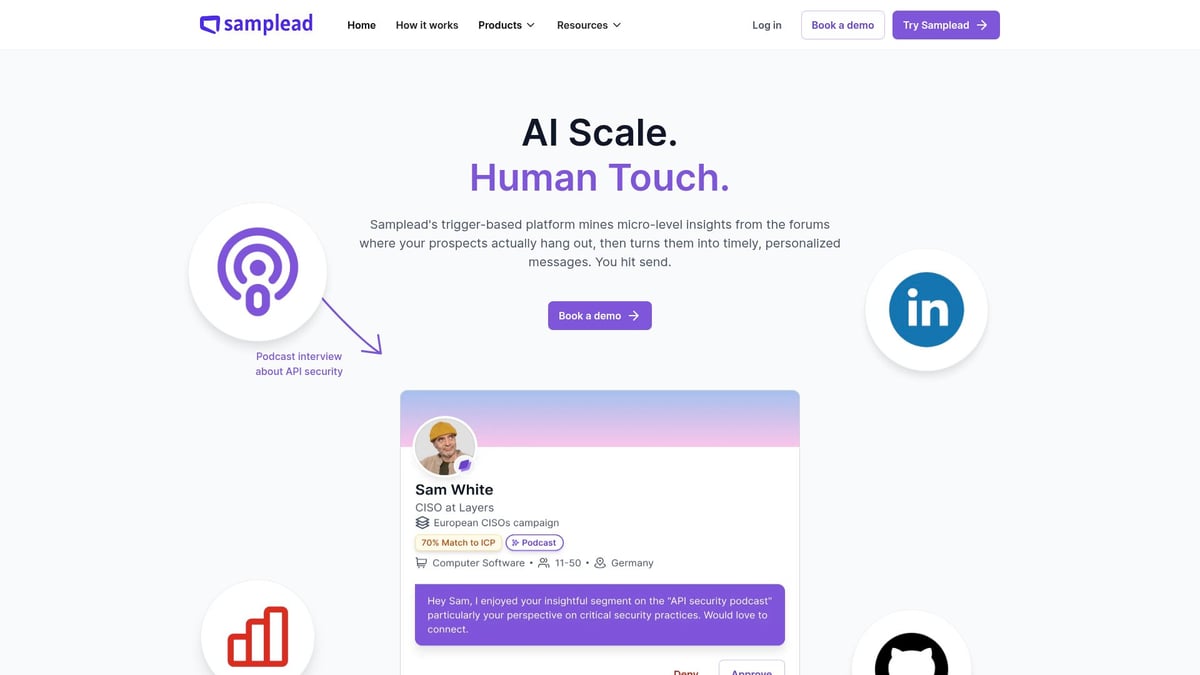
Samplead’s ai bdr integrates micro-level insights from forums, podcasts, and digital footprints to deliver timely, relevant outreach. Sales teams can scale their pipeline efficiently without sacrificing the personal touch that distinguishes top performers.
The Best AI BDR Tools & Platforms for 2025
Selecting the right ai bdr platform can make or break your sales automation strategy in 2025. The market is evolving fast, and top tools now combine machine learning, real-time data, and seamless integrations to drive results. As adoption accelerates, 60% of sales organizations have already integrated AI to enhance their processes, according to AI Adoption in B2B Sales Statistics.
Below, we break down the leading ai bdr tools you should consider, each with unique strengths for modern sales teams.
Artisan: End-to-End Outbound Automation
Artisan is a powerhouse for ai bdr teams looking to automate outbound demand generation from start to finish. With access to over 300 million B2B leads, it streamlines prospecting, personalization, and multichannel sequencing in a single platform.
Key features include:
- Personalization waterfall for tailored outreach
- Deep CRM integrations for seamless workflow
- Multichannel support (email, LinkedIn, more)
- Continuous learning from campaign performance
Artisan is ideal for teams aiming to scale their outbound efforts without losing the strategic direction that ai bdr processes require.
Clay: Multi-Channel Outreach & Lead Enrichment
Clay empowers ai bdr workflows by aggregating and enriching leads from a wide range of sources. It excels at data-driven prospecting, syncing real-time information to ensure your lists are always up to date.
Highlights:
- Automated enrichment from social, company, and news data
- Multi-channel outreach (email, LinkedIn, social)
- Seamless CRM integration
- Granular filtering for highly targeted campaigns
Clay stands out for its ability to unify data and orchestrate outreach, making it a favorite among data-driven sales teams focused on ai bdr optimization.
Reply.io: Sentiment Analysis & Email Automation
Reply.io is built for ai bdr teams that prioritize scalable, personalized email outreach. Its AI-driven sentiment analysis reads replies and adjusts sequences for better engagement.
Notable features:
- Automated cold email sequences
- Real-time engagement tracking
- Sentiment analysis for smarter follow-ups
- CRM integration for streamlined sales operations
Reply.io is a go-to for sales teams needing efficient, responsive, and scalable communication powered by ai bdr technology.
6sense: Predictive Lead Scoring & Intent Data
6sense brings predictive analytics to the ai bdr toolkit, enabling teams to capture buying signals and prioritize leads with high conversion potential. It customizes messaging based on where prospects are in the buying journey.
Core advantages:
- Predictive lead scoring using intent data
- Real-time campaign optimization insights
- Custom messaging aligned with buyer stage
- Integration with major sales platforms
6sense is best for teams ready to move beyond basic outreach and leverage advanced ai bdr analytics for targeted, high-intent campaigns.
Klenty: CRM-Native AI Engagement
Klenty is designed for sales teams seeking a deeply integrated ai bdr solution within their CRM environment. It streamlines engagement, automates follow-ups, and provides robust analytics.
Key functions:
- Automated account research and outreach
- Multi-channel support (email, calls, LinkedIn)
- Deep CRM integration for seamless workflow
- Actionable analytics to refine strategies
Klenty simplifies pipeline management and enhances engagement, making it a strong choice for teams focused on CRM-driven ai bdr automation.
GPTBots: AI SDRs for Multi-Channel Lead Generation
GPTBots delivers ai bdr capabilities across a broad range of communication channels, deploying AI SDRs that engage prospects on WhatsApp, Facebook, Instagram, Telegram, and more.
Features include:
- End-to-end lead management
- Personalized, real-time conversations
- Advanced analytics and reporting
- Easy integration with existing tools
GPTBots is perfect for businesses that need wide channel coverage and want to harness the full potential of ai bdr agents for lead generation and nurturing.
Implementation Challenges & Future Trends in AI BDRs
AI BDR adoption is accelerating, but success comes with careful planning. As organizations scale automated sales, leaders must navigate new risks and evolving trends to realize the full potential of ai bdr solutions.
Over-Automation & Data Privacy Risks
Scaling with ai bdr tools introduces a risk of generic outreach that fails to resonate. Over-automation can result in impersonal messages, damaging brand trust and causing prospects to disengage.
Data privacy is another critical concern. With ai bdr platforms processing vast amounts of customer data, compliance with regulations like GDPR and CCPA is non-negotiable. Mishandling data can expose companies to regulatory penalties and reputational harm.
To mitigate these risks, organizations must implement transparent data practices and regularly audit ai bdr workflows. According to AI's Impact on B2B Sales, leading companies see up to a 50% increase in customer acquisition by prioritizing responsible AI use.
Human Oversight for Complex Deals
While ai bdr systems excel at repetitive outreach and lead qualification, they lack emotional intelligence and nuanced judgment. Human oversight remains essential for building relationships, handling objections, and closing complex deals.
A best practice is to let ai bdr technology manage top-of-funnel tasks, such as lead research and initial engagement. Human sales reps then step in to nurture warm leads and negotiate terms. This collaboration ensures that prospects receive both efficiency and a personalized touch.
By blending ai bdr automation with human expertise, sales teams can scale without sacrificing deal quality or customer trust.
Emerging Trends: Voice AI & Video Scripts
The ai bdr landscape is rapidly evolving. Voice AI is enabling automated agents to conduct real-time cold calls, leveraging speech recognition and natural conversation flows. Sales teams can also use AI-generated video scripts for personalized outreach, making messages more engaging.
These innovations help ai bdr systems reach prospects on their preferred channels and adapt to changing buyer behaviors. As adoption grows, expect to see ai bdr platforms integrating more multimedia capabilities, from voice to video, to drive higher response rates.
Sales leaders who embrace these trends will stay ahead of the curve in 2025.
Ethical Frameworks & Authenticity in Outreach
As ai bdr adoption becomes mainstream, ethical standards are crucial. Companies must ensure transparency in how AI interacts with prospects and manages data. Unbiased operations and honest messaging build long-term trust with customers.
A rising trend is the development of industry frameworks that promote fairness and authenticity in ai bdr outreach. Regular audits and human approval steps help maintain brand integrity and compliance.
For more on optimizing ai bdr processes and safeguarding quality, see Measuring SDR Success with AI Tools.