In today’s fiercely competitive B2B world, relying on inbound alone is not enough—outbound sales is the proactive engine that drives rapid growth in 2025. This guide arms you with the most current, proven outbound sales techniques so you can build, scale, and optimize a high-performing outbound engine. Discover the fundamentals, follow a step-by-step outbound process, leverage the latest tools, and apply actionable strategies that deliver results. Outbound sales creates urgency, unlocks predictable pipeline growth, and gives you the practical edge to win more deals this year.
Outbound Sales Fundamentals: What Every Sales Leader Must Know
Modern sales leaders know that outbound sales is not just a tactic, but a core growth engine. Understanding the essentials of outbound sales helps you build a winning team and strategy for 2025.

What Is Outbound Sales?
Outbound sales is a proactive approach where sales reps directly reach out to potential buyers, initiating contact instead of waiting for inbound leads. This method puts your team in control, letting you target specific prospects with precision.
Key roles in outbound sales include Sales Development Representatives (SDRs), who focus on prospecting and qualifying, and Account Executives, who close deals. Outbound sales is especially valuable for high Annual Contract Value (ACV) B2B companies, SaaS providers, and organizations seeking rapid, controlled growth.
For example, a SaaS company might deploy SDRs to target decision-makers within a specific industry, ensuring every outreach is purposeful. Outbound sales enables you to shape your pipeline and drive consistent results.
Outbound vs. Inbound: Key Differences and When to Use Each
Outbound sales is all about proactive outreach. Your team identifies and contacts high-value prospects, leading to faster pipeline creation and greater control over lead quality. In contrast, inbound relies on content and marketing to attract leads, but often takes longer to generate results.
A hybrid model combines both strategies for optimal impact. For instance, Cognism uses inbound tactics to nurture interest, then applies outbound methods to qualify and convert leads efficiently.
| Aspect | Outbound Sales | Inbound Sales |
|---|---|---|
| Approach | Proactive | Reactive |
| Speed | Fast | Slower |
| Targeting | Precise | Broad |
| Control | High | Moderate |
Statistics from Salesforce and Cognism show outbound sales can dramatically increase pipeline velocity compared to inbound-only approaches.
Core Benefits of Outbound in 2025
Outbound sales brings several advantages for growth-focused teams in 2025. First, it enables rapid pipeline creation, letting you reach your targets faster than with inbound alone. Second, you can target specific segments, industries, or decision-makers, increasing your chances of landing ideal clients.
Direct conversations give real-time feedback, revealing market insights instantly. Outbound sales is scalable, with processes and campaigns that easily expand as your team grows. Reps also build vital skills, such as objection handling and pitch refinement, through frequent prospect interactions.
Over 4,000 companies use outbound platforms to speed up revenue. For more on evolving strategies, check out Outbound sales trends for 2024 and beyond, which explores what's next for outbound sales in the coming year.
The Role of Outbound in Modern Sales Teams
Outbound sales is now a primary driver of revenue, not just a supplementary tactic. Empowering SDRs and Account Executives to generate their own pipeline creates ownership and accountability.
Outbound sales is also essential in account-based marketing (ABM) and multi-channel strategies, where every touchpoint matters. It complements inbound by reaching prospects who may not engage with your content and reactivates dormant leads.
For example, outbound sales can target executives who haven't responded to marketing campaigns, ensuring no valuable opportunity slips by. In today's landscape, outbound sales is a must-have for any high-performing B2B sales team.
The 2025 Outbound Sales Process: Step-by-Step Blueprint
Mastering the outbound sales process in 2025 means following a structured, data-driven approach. Each step is critical for building a predictable pipeline and consistently winning new business. If you need a deeper dive into the full sales cycle, review this Understanding the outbound sales cycle resource for more detail.
Below, you will find a blueprint that breaks down each stage, from prospecting to post-sale nurturing, ensuring you leave nothing to chance.
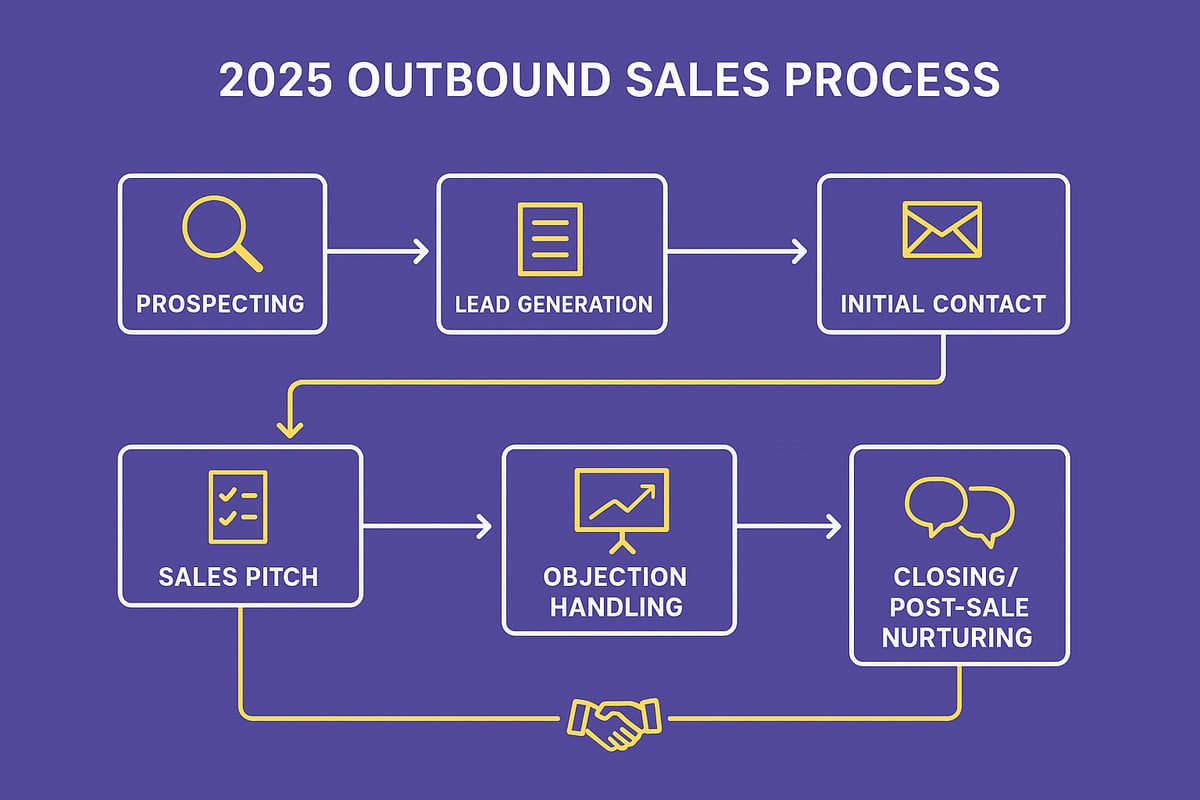
Step 1: Prospecting—Identifying High-Value Targets
The first stage in outbound sales is prospecting, where you pinpoint high-value leads who match your ideal customer profile (ICP). Research is essential, relying on tools like LinkedIn Sales Navigator, contact databases, CRM, and industry news to identify prospects showing buying signals.
Trigger-based prospecting is a top tactic for 2025. Look for recent funding rounds, hiring sprees, or notable news events. These triggers indicate readiness to engage. For example, a SaaS company can use LinkedIn Sales Navigator to create a list of decision-makers in a newly funded vertical.
Data shows that trigger-based outreach can increase reply rates by up to 10x, making this technique indispensable in outbound sales.
Step 2: Lead Generation and List Building
Once targets are identified, the next step in outbound sales is generating qualified leads and building targeted lists. Start by defining clear lead qualification criteria to ensure you focus on the right accounts.
Use data enrichment tools and intent data to enhance your lists with accurate, up-to-date information. Platforms like Cognism help teams access GDPR-compliant B2B data, reducing wasted effort on outdated contacts.
Always prioritize quality over quantity. Accurate data can triple your connect rates, ensuring your outbound sales efforts reach the right people at the right time. This foundation sets the stage for impactful outreach.
Step 3: Initial Contact—Personalized Outreach
After list building, the outbound sales process moves to initial contact. Use a multi-channel strategy, including cold calling, cold emailing, LinkedIn, and even direct mail, to maximize your reach.
Personalization is key. Reference recent triggers, such as a prospect's award or company news, and tailor each message for relevance. Best practice is to sequence outreach, spacing messages for optimal timing and frequency.
For example, mention a recent achievement in your outreach to catch attention. Salesforce data shows that personalized outreach in outbound sales leads to higher response rates and more engaged prospects.
Step 4: Lead Qualification and Discovery
At this stage, outbound sales shifts toward qualification and discovery. Use frameworks like BANT, CHAMP, or MEDDIC to guide your conversations and assess fit.
Ask open-ended questions to uncover authority, need, budget, and timing. This step is crucial for filtering out leads who are not ready or not a good fit, saving your team valuable time and resources.
A skilled SDR might qualify a prospect’s readiness for a demo by confirming their pain points and buying timeline. Remember, qualified leads in outbound sales are twice as likely to convert as unqualified ones.
Step 5: Sales Pitch and Value Demonstration
Delivering a compelling sales pitch is the heart of outbound sales. Focus your messaging on the prospect’s pain points, using storytelling and data to show how your solution addresses their needs.
Support your pitch with product demos, case studies, and ROI calculators. Highlight recent challenges your product has solved for similar companies to build credibility.
For example, demonstrate how your platform resolved a specific industry problem. Salesforce insights reveal that value-focused pitches in outbound sales consistently increase overall win rates.
Step 6: Objection Handling and Negotiation
Objection handling is a defining skill in outbound sales. Active listening helps you surface real objections, while empathy and evidence-based responses build trust.
Common objections include budget, timing, or competing solutions. Overcome them by clarifying concerns and providing proof, such as ROI calculations or client testimonials.
If a prospect says there is no budget, illustrate the long-term savings your solution delivers. Cognism reports that reps skilled in objection handling close 30% more outbound sales deals, proving this step’s impact.
Step 7: Closing, Follow-Up, and Post-Sale Nurturing
The final step in outbound sales is closing, which includes negotiating terms, finalizing contracts, and ensuring a seamless handoff to customer success.
Follow-up is essential after the sale, both for nurturing relationships and identifying upsell or cross-sell opportunities. Consistent, thoughtful engagement keeps your brand top of mind.
For instance, an Account Executive who follows up post-sale can nurture trust and increase the likelihood of future business. Effective follow-up in outbound sales also drives higher upsell rates, according to Salesforce data.
Essential Outbound Sales Techniques for 2025 Success
Winning in outbound sales today is about much more than dialing down a generic script. To stand out in 2025, you need a toolkit of modern techniques, blending technology with a personal touch. Let’s break down the essential outbound sales strategies that top teams use to deliver results, close deals faster, and consistently fill the pipeline.
Multi-Channel Outreach: Integrating Calls, Email, and Social
Modern outbound sales demands a multi-channel approach. Relying on just one method, like cold calling, limits your reach and effectiveness. Instead, blend calls, emails, LinkedIn messages, and even video outreach to engage prospects where they are most active.
A typical five-touch sequence might look like this:
- Day 1: Personalized LinkedIn connection request
- Day 2: Custom email referencing recent company news
- Day 3: Follow-up phone call
- Day 5: LinkedIn voice note or video message
- Day 7: Final email with a valuable resource
This coordinated approach boosts response rates by up to three times. For more actionable techniques, explore these effective strategies for outbound sales to enhance your results.
Trigger-Based Prospecting: Timing Your Outreach
Timing can make or break your outbound sales efforts. Trigger-based prospecting involves monitoring real-time signals, such as funding rounds, leadership changes, or company expansions.
Set up alerts for:
- Recent funding announcements
- New executive hires
- Industry awards or media features
- Product launches or market entries
When you reach out after a trigger event, your outbound sales message is far more relevant and likely to get a reply. In fact, teams using trigger-based outreach report meeting rates up to ten times higher than standard methods.
Personalization at Scale: Beyond “First Name”
Personalization is no longer just about inserting a name into an email. High-performing outbound sales teams dig deeper, referencing a prospect’s role, recent achievements, or even a LinkedIn post.
Use these tactics:
- Research each contact’s current projects or challenges
- Mention mutual connections or shared groups
- Reference recent company news or social activity
AI tools can help automate research, but always add a human touch to make every message count. Deep personalization can increase reply rates by up to ten times compared to generic outreach.
Human + AI: Empowering, Not Replacing, Sales Teams
AI is reshaping outbound sales by handling repetitive research, data entry, and workflow automation. However, it’s the human element that builds trust and closes deals.
Let AI handle:
- Prospect data enrichment
- Lead scoring and prioritization
- Automated reminders and follow-ups
Meanwhile, SDRs and AEs focus on meaningful conversations, discovery, and relationship-building. The best outbound sales teams combine AI efficiency with authentic, human-driven engagement for superior results.
Quality Over Quantity: Focusing on ICP and High-Intent Leads
Gone are the days of mass-blasting emails to every contact. Outbound sales success in 2025 centers on targeting your ideal customer profile (ICP) and prioritizing high-intent leads.
Strategies include:
- Building lists based on firmographic and technographic data
- Focusing on accounts with recent buying signals
- Aligning with marketing to ensure message consistency
This focus on quality improves conversion rates and ensures your outbound sales efforts generate real revenue, not just activity.
Data-Driven Optimization: Measuring and Refining Your Approach
Data is the backbone of every high-performing outbound sales team. Track key metrics like connect rates, reply rates, meetings booked, and pipeline velocity to refine your approach.
Consider this table for essential KPIs:
| Metric | Why It Matters |
|---|---|
| Connect Rate | Gauges initial engagement |
| Reply Rate | Measures message effectiveness |
| Meetings Booked | Tracks conversion to pipeline |
| Pipeline Velocity | Shows speed to revenue |
Regular A/B testing and weekly reviews help you adapt your outbound sales strategy as the market shifts. Data-driven teams consistently hit higher quotas and adapt faster than the competition.
Samplead: Trigger-Based Automated Outbound for High-ACV B2B
Samplead transforms outbound sales for high-ACV B2B companies by automating research and outreach based on real sales triggers. The platform only initiates contact after events like funding rounds or executive changes, ensuring every outbound sales touchpoint is timely and relevant.
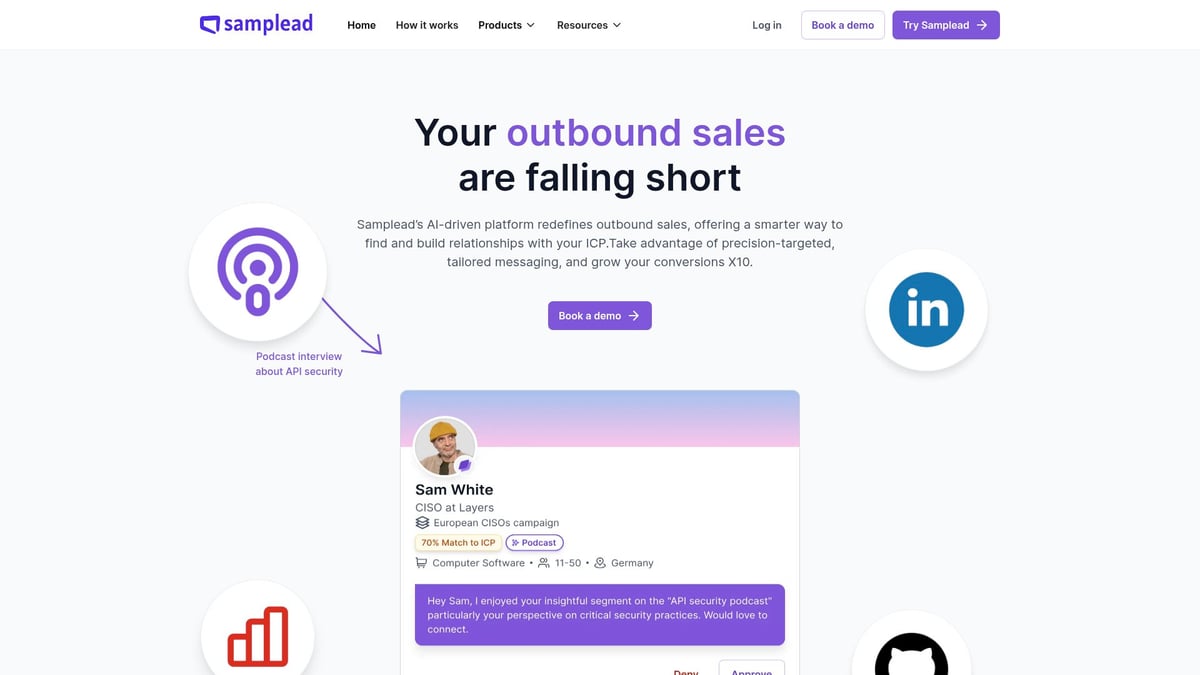
AI handles the heavy lifting—research, sequencing, and workflow automation—while sales reps review, approve, and personalize each message. Customers have reported a tenfold increase in reply and conversion rates, plus significant time savings each week. By focusing on quality over volume, Samplead helps teams book more high-value meetings and drive predictable revenue.
Outbound Sales Tools and Technology Stack for 2025
Building a high-performing outbound sales engine in 2025 demands a robust technology stack. The right tools streamline prospecting, automate outreach, and keep your team focused on what matters—closing deals. Let’s break down the essential components every modern outbound sales team needs to succeed.

Must-Have Tools for Modern Outbound Teams
A strong outbound sales stack starts with the right core platforms. Here’s a quick comparison of must-have tool categories:
| Tool Type | Top Examples | Key Benefit |
|---|---|---|
| CRM | Salesforce, HubSpot | Centralizes pipeline & data |
| Sales Engagement | Outreach, Salesloft | Automates multi-channel sequences |
| Data Providers | Cognism, Apollo | Delivers accurate, compliant data |
| Social Selling | LinkedIn Navigator | Advanced prospecting & targeting |
Combining these tools gives outbound sales teams a unified workflow, where prospect information flows from discovery to engagement seamlessly. Over 4,000 companies rely on Cognism for B2B data, showing just how critical reliable data providers are in outbound sales today.
AI and Automation: Enhancing Efficiency Without Losing the Human Touch
AI and automation have transformed outbound sales, making teams faster and more precise. AI can score leads, enrich data, and trigger alerts based on prospect activity, so reps always act at the right time. Automated workflows handle repetitive tasks like follow-ups and reminders, freeing up time for deeper relationship building.
However, the human touch remains essential. AI suggests prospects, but SDRs personalize messages and build trust. According to Samplead, AI-driven outbound sales teams save 15+ hours per week. For more on the latest automation innovations, see Future of Outbound Sales: Automation Trends.
Analytics and Reporting: Measuring What Matters
Outbound sales success is driven by data. Top teams track metrics like connect rates, reply rates, meetings booked, and pipeline health. Real-time dashboards enable sales leaders to spot trends and optimize campaigns quickly. Weekly reporting helps identify which sequences and messages perform best.
Using analytics to refine your outbound sales strategy is not optional in 2025. Analytics-driven teams consistently achieve higher quota attainment, according to Salesforce. To dive deeper into how measurement drives outbound sales results, check out Data-driven outbound optimization.
Integrations and Workflow Automation
Seamless integrations are the backbone of any modern outbound sales stack. Connecting your CRM, email, LinkedIn, and data providers ensures data flows automatically between systems. This reduces manual entry and ensures leads are routed to the right rep instantly.
- Automated data syncing keeps records up to date
- Workflow triggers launch outreach sequences based on CRM updates
- Integrated stacks boost sales productivity by 20 percent, according to Salesforce
With the right integrations, outbound sales teams spend less time on admin and more time engaging prospects.
Advanced Strategies: Scaling, Training, and Optimizing Outbound Teams
Building a world-class outbound sales operation requires more than just tools and tactics. To dominate in 2025, you need a team built for speed, agility, and continuous learning. Let’s break down the advanced strategies for scaling, training, and optimizing outbound sales teams to win in today’s competitive environment.
Building and Scaling a High-Performing Outbound Team
Every successful outbound sales program starts with the right people. Hire SDRs and AEs who are coachable, resilient, and eager to learn. Define clear roles—SDRs focus on prospecting and qualifying, while AEs handle closing and relationship management.
Invest in structured onboarding programs that cut ramp time and set expectations early. Collaboration between SDRs and AEs drives accountability and pipeline ownership. According to Cognism, teams with strong onboarding see 30% faster productivity.
Key steps:
- Hire for attitude, grit, and adaptability
- Clarify SDR vs. AE responsibilities
- Use onboarding checklists and peer mentoring
A high-performing outbound sales team is the engine for repeatable growth.
Training and Coaching for Outbound Excellence
Consistent training is the backbone of outbound sales excellence. Schedule regular call reviews and role-plays to sharpen messaging and objection handling. Use data to pinpoint skill gaps and tailor coaching sessions.
Stay ahead by incorporating AI-driven insights and modern sales trends. For example, Top Sales Prospecting Trends in 2025 highlights how AI is redefining prospecting and coaching in outbound sales teams.
Training best practices:
- Weekly call reviews and feedback
- Role-play common objections
- Analyze performance metrics to personalize coaching
Ongoing training can boost meeting bookings and improve rep performance by 25%, according to Salesforce.
Outbound Sales Metrics: What to Track and Why
Tracking the right metrics is crucial for optimizing outbound sales performance. Focus on KPIs that reveal true pipeline health and team effectiveness.
Core outbound sales metrics:
| KPI | Why It Matters |
|---|---|
| Calls/Emails Sent | Measures activity volume |
| Connect Rates | Tracks engagement effectiveness |
| Replies/Meetings | Shows pipeline progress |
| Pipeline Value | Quantifies sales opportunity |
| Win Rates | Assesses closing efficiency |
Set realistic benchmarks for each metric. Monitor meetings booked per SDR weekly and use these numbers to drive accountability and coaching.
Top-performing outbound sales teams consistently track 5–7 core KPIs for maximum impact.
Continuous Improvement: Feedback Loops and Process Optimization
Sustained outbound sales success relies on continuous improvement. Collect feedback from both reps and prospects to identify friction points and growth opportunities.
Regular process reviews and A/B testing help teams adapt to market shifts faster. For expert strategies on overcoming outbound prospecting challenges, see Outbound Prospecting in 2025: Challenges and Solutions.
Continuous improvement checklist:
- Monthly process reviews
- Implement feedback from calls and emails
- Experiment with new messaging and cadences
Teams with strong feedback loops are twice as agile in responding to change, ensuring outbound sales strategies stay sharp and effective.