Connect Through: The Art of Strategic B2B Engagement

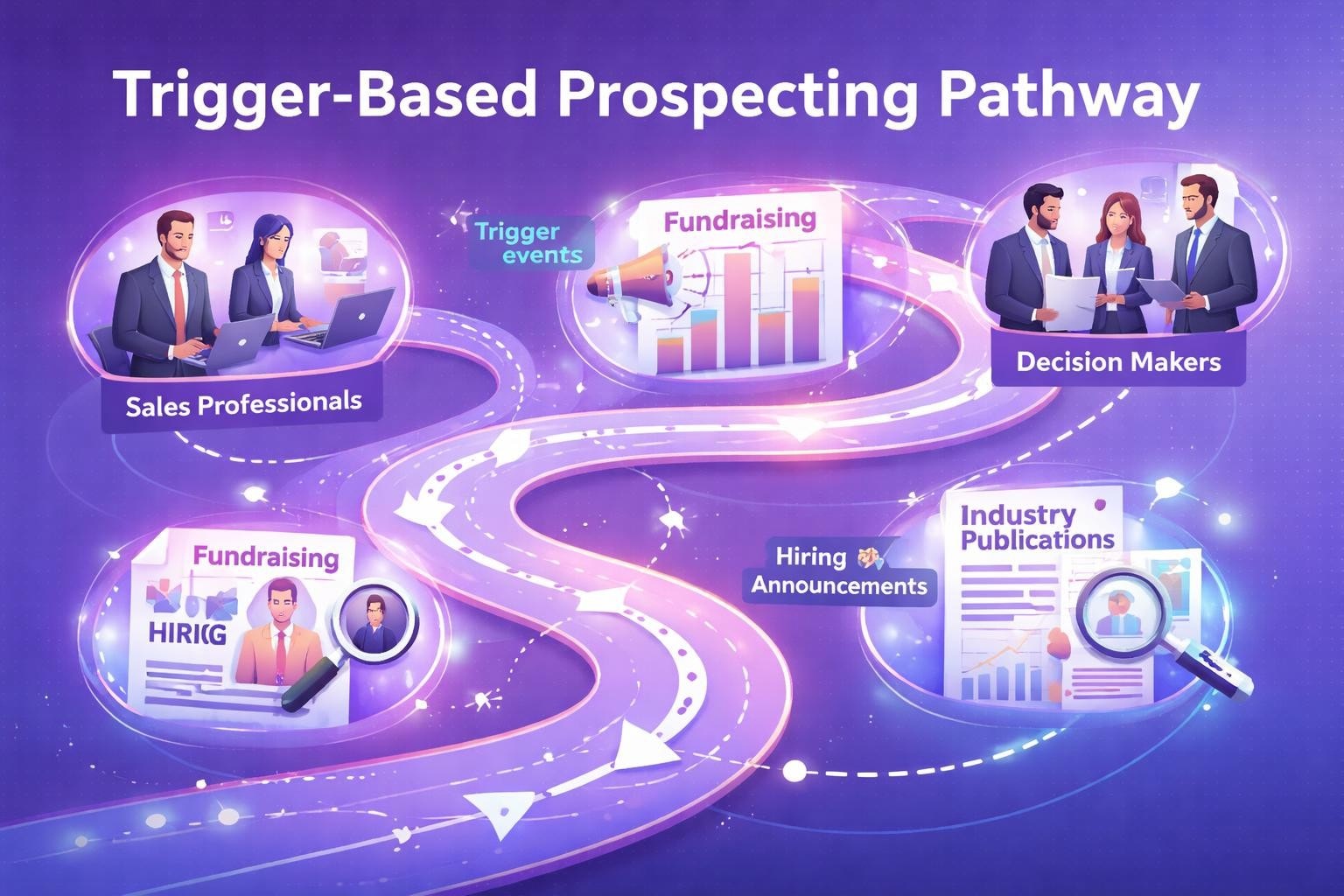
The ability to connect through meaningful touchpoints has become the defining characteristic of successful B2B sales in 2026. While countless organizations spam prospects with generic messages, elite sales teams understand that genuine connection requires identifying the precise moments when prospects are most receptive to conversation. This fundamental shift from volume-based to trigger-based outreach transforms how sales professionals engage with high-value accounts, replacing spray-and-pray tactics with strategic, timely interventions that demonstrate authentic understanding of a prospect's current business situation.
The Evolution of Strategic Connection in B2B Sales
Modern B2B buyers have developed sophisticated filters to ignore irrelevant outreach. They connect through channels that respect their time and demonstrate value immediately. The definition of connect emphasizes joining or linking together, yet most outbound efforts fail to create this genuine linkage between seller and buyer needs.
Traditional outbound strategies operated on the assumption that enough volume would eventually yield results. Sales teams would send thousands of generic messages weekly, hoping a small percentage would resonate. This approach has three critical flaws that undermine its effectiveness in today's market.
The fundamental problems with volume-based outreach:
- Message fatigue among decision-makers who receive dozens of irrelevant pitches daily
- Damaged brand reputation from being perceived as another spam sender
- Wasted sales resources on prospects who have no current buying intent
- Declining response rates that make the entire model economically unsustainable
The paradigm shift toward quality engagement requires sales teams to connect through signals that indicate genuine opportunity. Rather than reaching out to static lists, effective teams monitor for specific triggers that suggest a prospect might benefit from their solution right now.
Identifying Meaningful Triggers That Create Connection Opportunities
Trigger-based prospecting recognizes that timing is everything in B2B sales. A message sent at the right moment, referencing a relevant business event, achieves exponentially better results than generic outreach. The challenge lies in systematically identifying these moments at scale.
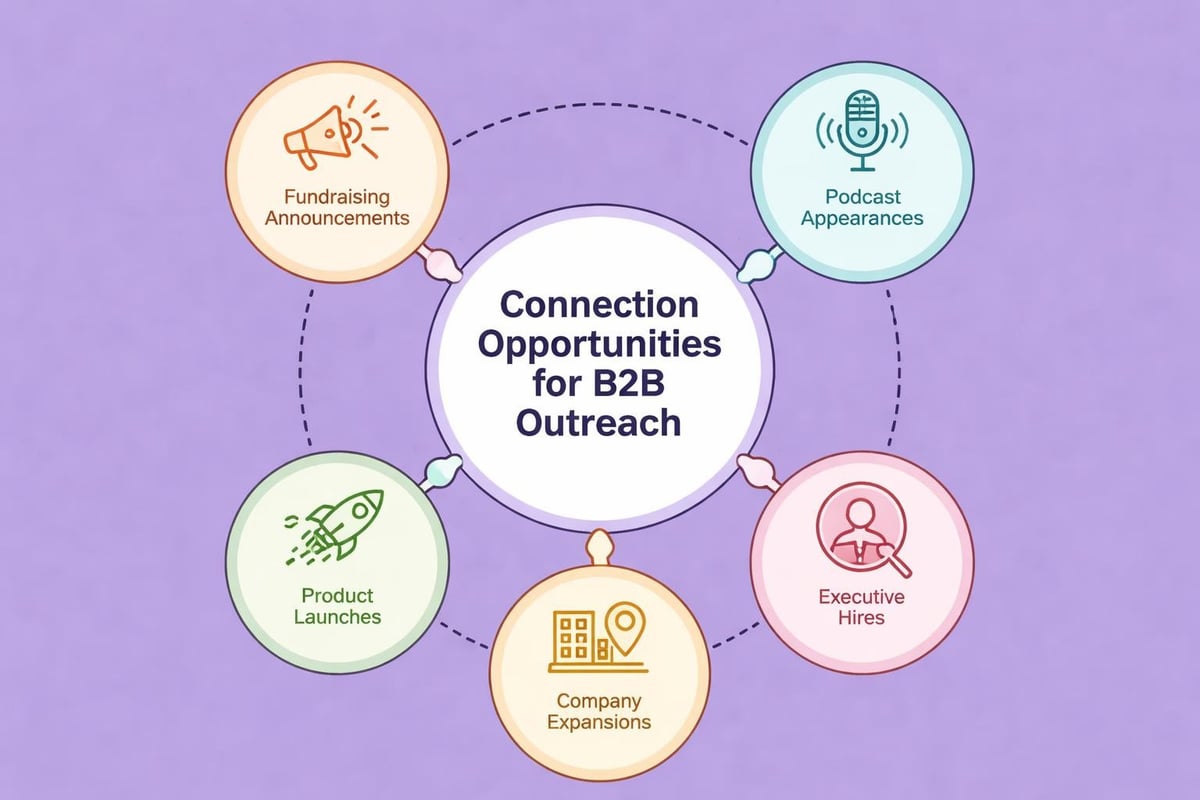
Consider the difference between these two approaches. A generic message states "I noticed your company works in X industry and thought our solution might help." This creates no meaningful connection. Alternatively, a trigger-based message references "I saw your recent $15M Series B announcement and your quoted focus on expanding into enterprise markets. Given your new growth trajectory, I wanted to share how similar companies navigating this transition have addressed the challenge of scaling outbound while maintaining quality."
The second approach demonstrates you connect through an understanding of their current business priorities. It's not just personalization-it's relevance born from timing and context.
| Trigger Type | Business Signal | Connection Opportunity |
|---|---|---|
| Fundraising | Capital infusion, expansion plans | Growth infrastructure, scaling solutions |
| Hiring | New executive roles, team expansion | Enablement tools, productivity solutions |
| Publication | Thought leadership, expertise sharing | Amplification support, related capabilities |
| Product Launch | Market expansion, new offerings | Complementary solutions, partnership opportunities |
| Conference Speaking | Industry visibility, expertise demonstration | Relationship building, expertise alignment |
Building Systems That Connect Through Intent Signals
Identifying triggers manually becomes impossible at scale. Sales teams need intelligent systems that monitor relevant signals across multiple sources and alert them when connection opportunities arise. This automation doesn't replace human judgment-it enhances it by surfacing the moments when human outreach will be most effective.
The architecture of trigger-based prospecting requires three components working together. First, monitoring systems that track relevant business events across news sources, social platforms, company announcements, and industry publications. Second, filtering logic that determines which triggers are genuinely relevant to your value proposition. Third, workflow automation that enables timely human response while maintaining quality.
The Human-AI Partnership in Outbound Excellence
The market has become saturated with AI SDR solutions promising to eliminate human involvement entirely. These tools generate messages, send outreach, and attempt to handle conversations autonomously. Yet they fundamentally misunderstand how enterprise buyers evaluate vendors.
Decision-makers want to connect through conversations with knowledgeable professionals who understand their specific challenges. They don't want to interact with bots, regardless of how sophisticated the natural language processing might be. The solution isn't replacing human sales professionals-it's empowering them with intelligence and automation that lets them focus on high-value activities.
What AI should handle:
- Monitoring thousands of potential accounts for relevant trigger events
- Filtering signals based on predefined relevance criteria
- Drafting personalized message frameworks based on specific triggers
- Scheduling and managing outreach timing across multiple sequences
- Tracking engagement and surfacing high-intent prospects
What humans should handle:
- Final review and customization of messages before sending
- All actual conversations and relationship building
- Strategic account planning and multi-threading
- Handling objections and complex sales discussions
- Closing deals and negotiating terms
This division of labor allows sales teams to connect through authentic human interaction while benefiting from the scale and efficiency that automation provides. The best AI sales tools recognize this balance, enhancing human capabilities rather than attempting to replace them.
Crafting Messages That Resonate Through Trigger Context
Once you've identified a relevant trigger, the message itself must demonstrate why this moment matters. Generic congratulations or vague value propositions waste the opportunity. Effective trigger-based messages follow a specific structure that creates immediate relevance.
The opening must reference the specific trigger and demonstrate you understand its implications. This immediately differentiates your message from spam. You connect through showing awareness of their current business reality, not just surface-level research.
The Anatomy of High-Converting Trigger Messages
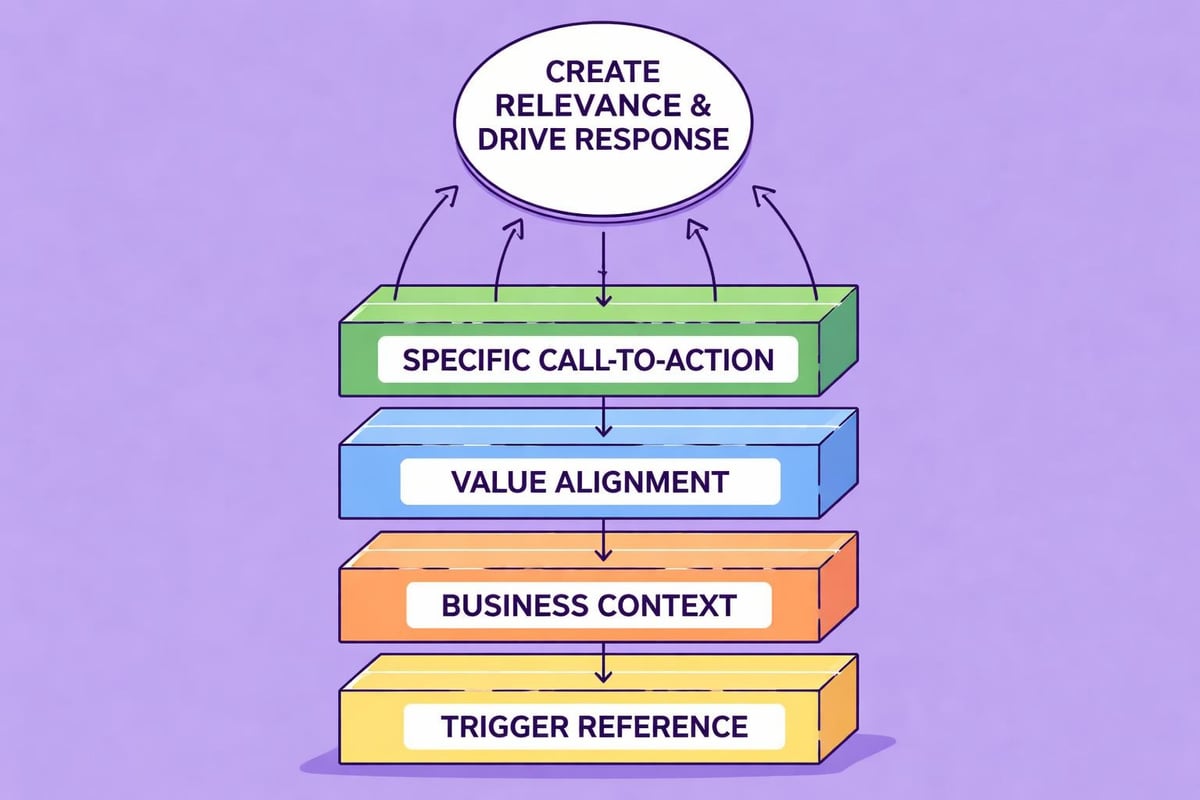
Consider a hiring trigger where a company just announced a new VP of Sales. A weak message says "Congratulations on your new hire." A strong message connects through understanding what this hire signals about company priorities and challenges.
- Trigger reference with context: "I saw you brought Sarah Johnson on as VP of Sales with her background scaling teams at [previous company]."
- Business implication insight: "This suggests you're likely prioritizing enterprise expansion and need to build scalable processes quickly."
- Relevant value alignment: "I work with recently funded B2B companies navigating exactly this transition."
- Specific next step: "Would it make sense to share how [similar company] built their outbound motion during a similar growth phase?"
This structure demonstrates you connect through genuine understanding rather than automated list-blasting. Each element builds credibility and relevance, making the prospect more likely to engage.
The language should mirror how you'd naturally connect the dots in a face-to-face conversation. Avoid corporate jargon or overly formal phrasing. Write as a knowledgeable peer offering insight, not a vendor pushing product.
LinkedIn as the Primary Channel for Strategic Connection
For B2B sales, LinkedIn remains the dominant platform where professionals expect to connect through business-focused conversations. Unlike email, which has become increasingly cluttered, LinkedIn messages from relevant connections still achieve strong open and response rates when properly executed.
The platform provides natural visibility into trigger events through company updates, job changes, posts, and engagement activity. Sales professionals can monitor their target accounts directly and respond to relevant triggers within the same platform where the signal appeared.
LinkedIn trigger opportunities:
- Profile updates indicating role changes or promotions
- Company announcements about funding, products, or expansions
- Original content posts demonstrating thought leadership
- Engagement with industry topics relevant to your solution
- Shared connections that can facilitate warm introductions
However, LinkedIn effectiveness depends entirely on how you connect through the platform. Connection requests with generic notes get ignored. Messages that immediately pitch get blocked. The key is leveraging triggers to create genuine reasons for conversation.
When someone publishes an article on LinkedIn discussing challenges your solution addresses, that's a clear signal to connect through thoughtful commentary on their insights. When a target account announces expansion into a geography where you have relevant case studies, that's your moment to reach out with specific, helpful context.
The proven tips for increasing your response rate on LinkedIn emphasize this principle: relevance and timing matter more than volume and persistence.
Measuring What Matters in Quality-First Outbound
Traditional outbound metrics focus on activity volume-messages sent, calls made, emails delivered. These measurements made sense when success came from playing a numbers game. Trigger-based approaches require different success indicators that reflect quality over quantity.
The first metric shift involves measuring trigger identification accuracy. How many of the triggers your system surfaces actually represent genuine connection opportunities? A system that flags 1,000 irrelevant events wastes more time than one that identifies 50 highly relevant moments.
| Traditional Metric | Quality-Focused Alternative | Why It Matters |
|---|---|---|
| Messages sent per day | Trigger-qualified prospects engaged | Measures relevance, not just activity |
| Total outreach volume | Response rate percentage | Reflects message quality and timing |
| Accounts contacted | Conversations initiated | Emphasizes actual engagement |
| Activity completed | Opportunities created | Links efforts to revenue outcomes |
| Time spent prospecting | Time spent in qualified conversations | Optimizes for valuable interactions |
Response rate serves as the ultimate validation of your approach. When you consistently connect through relevant triggers with timely, contextual messages, response rates should significantly exceed industry benchmarks. Low response rates indicate either poor trigger selection, weak messaging, or mistimed outreach.
Beyond Initial Response to Conversion Quality
Getting replies matters only if those replies lead to qualified opportunities. Some triggers generate high response rates but low conversion because they attract curiosity without indicating genuine buying intent. Measuring the full funnel from trigger to closed deal reveals which event types truly predict revenue potential.
For example, fundraising announcements might generate strong response rates because people appreciate recognition. However, podcast appearances might convert better because they indicate prospects actively building their personal brand and likely more open to solutions that support this goal. Understanding these patterns allows you to prioritize trigger types that drive actual business results.
The path from trigger to deal isn't always direct. Sometimes the first trigger-based conversation doesn't immediately convert but establishes a relationship that pays off months later when the timing aligns with budget cycles. Effective measurement tracks both immediate conversion and longer-term relationship development initiated through trigger-based engagement.
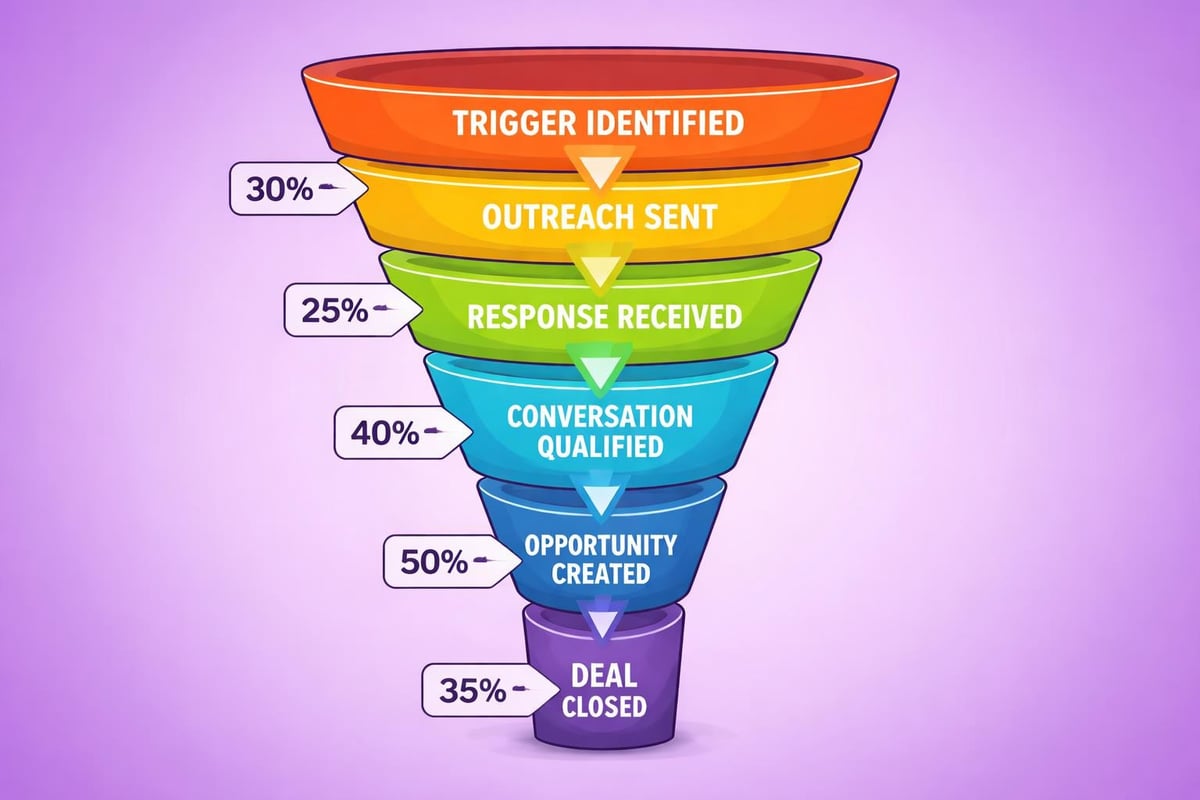
Game-changing outbound sales agency strategies recognize that measurement frameworks must evolve alongside tactical approaches. What worked for volume-based outbound doesn't capture the nuances of trigger-based quality engagement.
Scaling Personal Without Sacrificing Authenticity
The challenge many sales leaders face is maintaining message quality while reaching enough prospects to hit pipeline targets. This tension between scale and authenticity has driven many toward fully automated solutions that sacrifice connection quality for volume efficiency.
The solution lies in thoughtful automation that preserves human judgment at critical moments. Systems can monitor triggers, draft message frameworks, and manage sequences-but humans should review and customize before sending. This hybrid approach lets one sales professional connect through relevant triggers with hundreds of prospects monthly while maintaining the authentic, contextual communication that drives response.
Template frameworks provide structure without forcing generic content. A well-designed template for fundraising announcements includes placeholders for company name, funding amount, investor names, and stated growth priorities. The sales professional fills these details and adds one or two sentences of genuine insight based on their understanding of the prospect's industry or specific situation.
This approach achieves 80% efficiency from automation while preserving the 20% of human customization that drives 80% of the results. You connect through messages that feel personal because they are-they're just built on efficient frameworks that eliminate redundant work.
Industry-Specific Trigger Strategies
Different industries present unique trigger opportunities that signal buying intent or receptiveness to conversation. Sales teams must identify which events matter most for their specific target market and build monitoring around those signals.
Technology companies might prioritize product launch announcements, technical blog posts, GitHub activity for developer-focused solutions, or engineering leadership hires. These triggers indicate technical priorities and potential need for related tools or infrastructure.
Professional services firms could focus on new client wins, office expansions, partner promotions, or thought leadership publications. These signals suggest growth, evolving service offerings, or capability gaps where your solution provides value.
Manufacturing and industrial businesses respond to different triggers: facility expansions, supply chain announcements, sustainability initiatives, or regulatory compliance deadlines. Understanding industry-specific challenges allows you to connect through offering relevant expertise at precisely the right moment.
The key is mapping your solution's value proposition to observable business events that indicate need. If you help companies manage rapid growth, fundraising and aggressive hiring are clear triggers. If you solve compliance challenges, regulatory changes and leadership appointments in legal or compliance roles signal opportunity.
Common Pitfalls That Undermine Trigger-Based Connection
Even with trigger identification, many teams fail to connect through effectively because they fall into predictable traps. Understanding these pitfalls prevents wasted effort and preserves the power of trigger-based approaches.
Mistiming the outreach: Reaching out too soon after a trigger makes you seem like you're just monitoring news feeds. Waiting too long means you've lost the moment of relevance. The optimal window varies by trigger type but generally falls between 24-72 hours after the public announcement.
Over-emphasizing the trigger: Your message shouldn't just congratulate or acknowledge the event. It must connect through showing why this trigger creates mutual value. The trigger is the door-opener, not the entire conversation.
Neglecting follow-up sequences: One message rarely converts enterprise prospects. You need multi-touch sequences that reference the original trigger while adding new value in each subsequent message. This demonstrates persistence without becoming spam.
Failing to research beyond the trigger: The trigger alerts you to reach out, but your message must demonstrate broader understanding of the company, industry, and strategic context. Surface-level trigger references without depth fail to build credibility.
Using triggers as an excuse for pitching: The worst implementations treat triggers as new justifications for the same generic pitch. This misses the entire point. Triggers should inform genuinely different conversations tailored to the specific business moment.
Avoiding these mistakes requires discipline and genuine commitment to quality over quantity. It means sometimes not reaching out when a trigger occurs because your research reveals it's not actually relevant to your value proposition.
Future-Proofing Your Outbound Strategy
The B2B sales landscape continues evolving rapidly. Buyer expectations rise, competitive noise increases, and technological capabilities expand. Organizations that connect through trigger-based quality engagement position themselves to adapt as market conditions shift.
Several trends will shape effective outbound approaches in the coming years. First, data sources for trigger identification will expand beyond obvious public announcements to include more nuanced signals like technology adoption patterns, employee sentiment indicators, and competitive intelligence. Teams that leverage these emerging signals will identify opportunities their competitors miss.
Second, buying committees will continue expanding, requiring multi-threaded approaches that connect through multiple stakeholders within target accounts. Single-contact strategies fail in complex enterprise sales. Trigger-based approaches must evolve to identify relevant events across different personas and departments.
Third, buyers will increasingly expect personalization not just in initial outreach but throughout the entire sales journey. The ability to connect through relevant context must extend from first message through proposal, presentation, and negotiation. This requires systems that maintain contextual awareness across all touchpoints.
Organizations building trigger-based capabilities now develop competitive advantages that compound over time. They build repositories of trigger-response patterns, refine their monitoring systems, and develop teams skilled at leveraging timing for competitive advantage. These capabilities become increasingly difficult for competitors to replicate as they mature and optimize.
The fundamental principle remains constant: quality engagement delivered at the right moment outperforms high-volume generic outreach. As markets become more sophisticated, this gap will only widen. The teams that master how to connect through meaningful triggers will dominate their markets while others struggle with declining response rates and rising customer acquisition costs.
The shift from volume-based to trigger-based outbound represents a fundamental evolution in how B2B sales teams connect through with their target markets, prioritizing timely relevance over relentless persistence. By identifying meaningful business events and engaging prospects at precisely the right moment with contextual, valuable outreach, sales organizations achieve superior results while building stronger market reputations. Samplead empowers high-ACV B2B sales teams to execute this strategy at scale by automating trigger identification and outreach workflows while keeping humans in control of every conversation, ensuring your team connects through authentic engagement that drives real pipeline growth.